Representative Image

Thermo Scientific LYNX 4000, Centrifuge, 380-415 V, 50/60 Hz

Max. voltage

Min. voltage

Power supply

Specifications

Compare models
Depth
805 mm
Dimensions (WxDxH)
700 x 805 x 930 mm
Power supply frequency
50/60 Hz
Height
930 mm
Max. rcf
68905 x g
Max. speed
24000 1/min
Max. temperature
40 °C
Max. voltage
415 V
Min. speed
500 1/min
Min. temperature
-10 °C

NTD 2,187,825

Inc. VAT

Available soon

Product description

The Thermo LYNX 4000 Centrifuge, 380 to 415 V, 50/60 Hz is a superspeed centrifuge designed for high-performance separations in research and bioprocessing applications. Featuring GreenCool technology, it helps reduce environmental impact while supporting ozone-friendly operation for everyday laboratory use.

Key Features:

  • Brand: Thermo
  • Model: LYNX 4000
  • Type: Superspeed centrifuge
  • Voltage: 380 to 415 V
  • Frequency: 50/60 Hz
  • Technology: GreenCool technology for reduced environmental impact and ozone-friendly operation
  • User Interface: Bright, easy-to-read touchscreen that can be operated with gloves
  • Rotor Identification: Auto-ID rotor identification automatically recognises the rotor and adjusts device parameters
  • Rotor Change: Auto-Lock enables quick and easy rotor change at the touch of a button
  • Run Time: Up to 99 h 59 min 59 s, with continuous operation
  • Functions: Automatic lid opening and pre-cooling function
  • Profiles: 9 acceleration profiles, 10 deceleration profiles, and brake-off option
  • Traceability: Supports GMP/GLP-compliant traceability with optional Centri-Log Plus Data Management software
  • Remote Monitoring: Real-time run monitoring and basic remote control via the Centri-Vue app

This Thermo LYNX 4000 centrifuge is suitable for laboratories requiring reliable superspeed centrifugation with flexible rotor support, advanced run control, and efficient high-performance separation capability.


Frequently Asked Questions

1. What is the Thermo LYNX 4000 Centrifuge, 380 to 415 V, 50/60 Hz used for?

The LYNX 4000 is designed for the intended laboratory application. This superspeed centrifuge format supports routine laboratory work in that application.

2. What are the main specifications of the LYNX 4000?

The main specifications of the LYNX 4000 are that the traceability is Supports GMP/GLP-compliant traceability with optional Centri-Log Plus Data Management software, the frequency is 50/60 Hz and the run time is Up to 99 h 59 min 59 s, with continuous operation. These are the main selection points to compare with the requirements of the laboratory task.

3. Is the LYNX 4000 suitable for the intended laboratory application?

Yes. The LYNX 4000 is suitable for the intended laboratory application. The product is designed specifically for that type of work when its stated format and operating characteristics match the laboratory requirement.

4. What power requirement does the LYNX 4000 have?

The LYNX 4000 has a voltage specification of 380 to 415 V. This should be matched with the available laboratory power setup.

Accessories

Accessories for bioprocessing centrifuges BIOS and superspeed centrifuges LYNX

ProductDescriptionUNSPSCMfr#Part#AvailabilityPrice
Network access kit41103913750077414.712 496NTD 21,419
Centri-Log™ Plus software41103913750077424.712 497NTD 369,471
Sample tracking kit41103913750077404.712 495NTD 56,672

Swing-out rotor BIOFlex™ HC for superspeed centrifuges LYNX

ProductTypeMax. rcfMfr#Part#AvailabilityPrice
BIOFlex™ HC7068 x g750030006.273 865NTD 582,146

Compare similar models

LYNX 4000  centrifuge 380-415V 50/60Hz

Manufacturer P/N

75008581

Part Number

4.712 499

Manufacturer

Thermo Scientific

Max. voltage

415 V

LYNX 4000 centrifuge 200-240V 50/60Hz

Manufacturer P/N

75008580

Part Number

4.712 498

Manufacturer

Thermo Scientific

Max. voltage

240 V

Insights

Explore
Cleaning Lab Glassware: Removing Stubborn Residue

1 min read

Cleaning Lab Glassware: Removing Stubborn Residue

Cleaning laboratory glassware properly is essential for accurate, safe, and repeatable lab work. This guide explains how to remove stubborn residue from beakers, flasks, bottles, volumetric glassware, and other lab glassware, including grease, dried salts, biological residue, stains, and burnt deposits. It also covers safe cleaning methods, common mistakes, drying and storage tips, and when damaged glassware should be replaced.
Read full story
How to Calibrate Your Pipettes to ISO 8655 Standards

1 min read

How to Calibrate Your Pipettes to ISO 8655 Standards

Pipette calibration helps laboratories confirm that liquid handling results remain accurate, repeatable, and traceable. This guide explains how pipettes are calibrated to ISO 8655 standards, including gravimetric testing, environmental control, correct tip selection, volume testing, calibration records, and common mistakes to avoid. It also covers when to use in-house calibration and when an external calibration service may be more suitable.

Read full story
Molarity and Dilution Calculator

1 min read

Molarity and Dilution Calculator

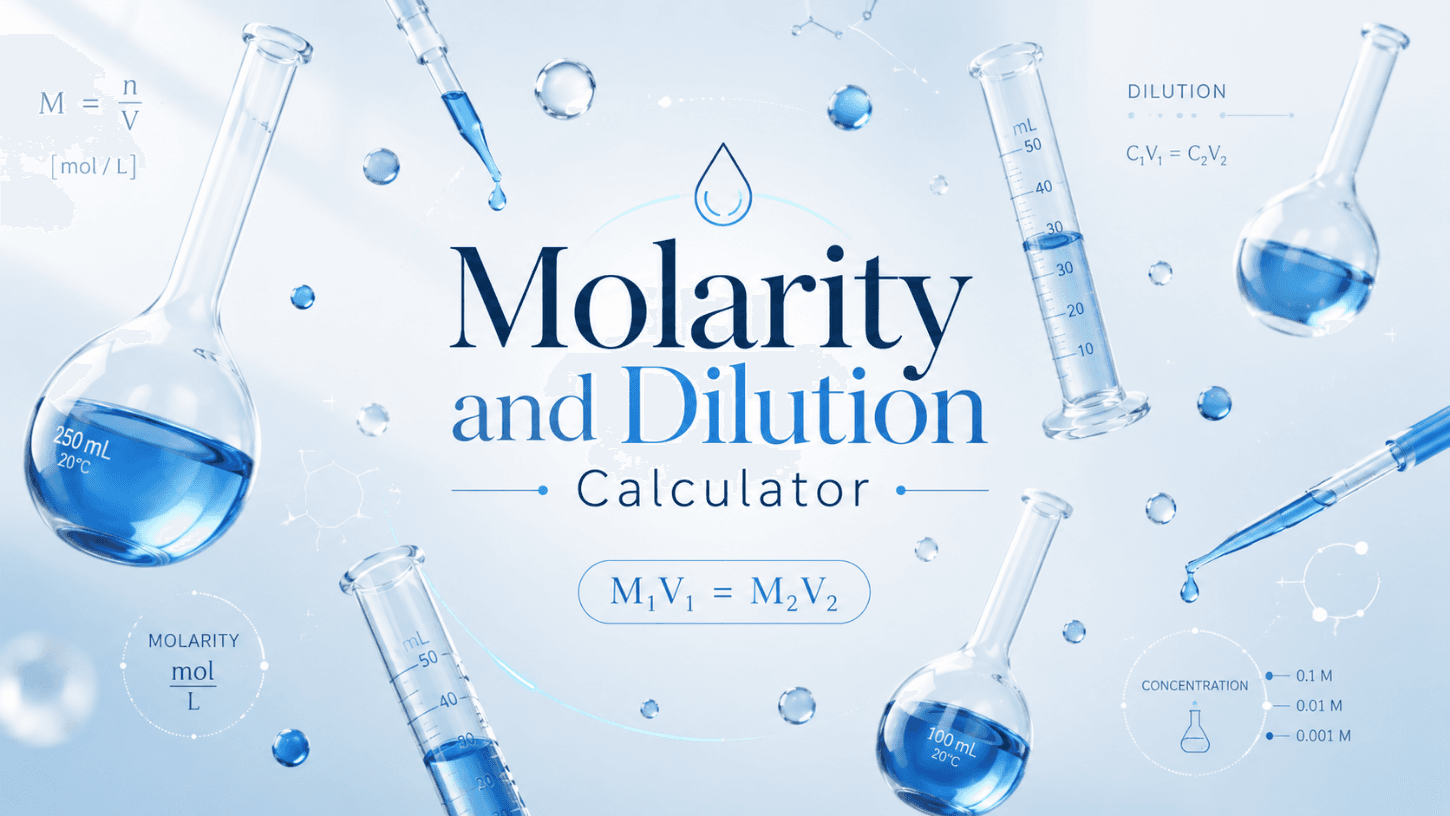
A free molarity and dilution calculator covering four essential lab calculations: C1V1=C2V2 dilution (solve for any unknown), molarity from mass, mass from molarity, and serial dilution table generation. Includes worked examples, a concentration units guide and step-by-step preparation instructions for every result.

Read full story
Buffer Preparation Calculator

1 min read

Buffer Preparation Calculator

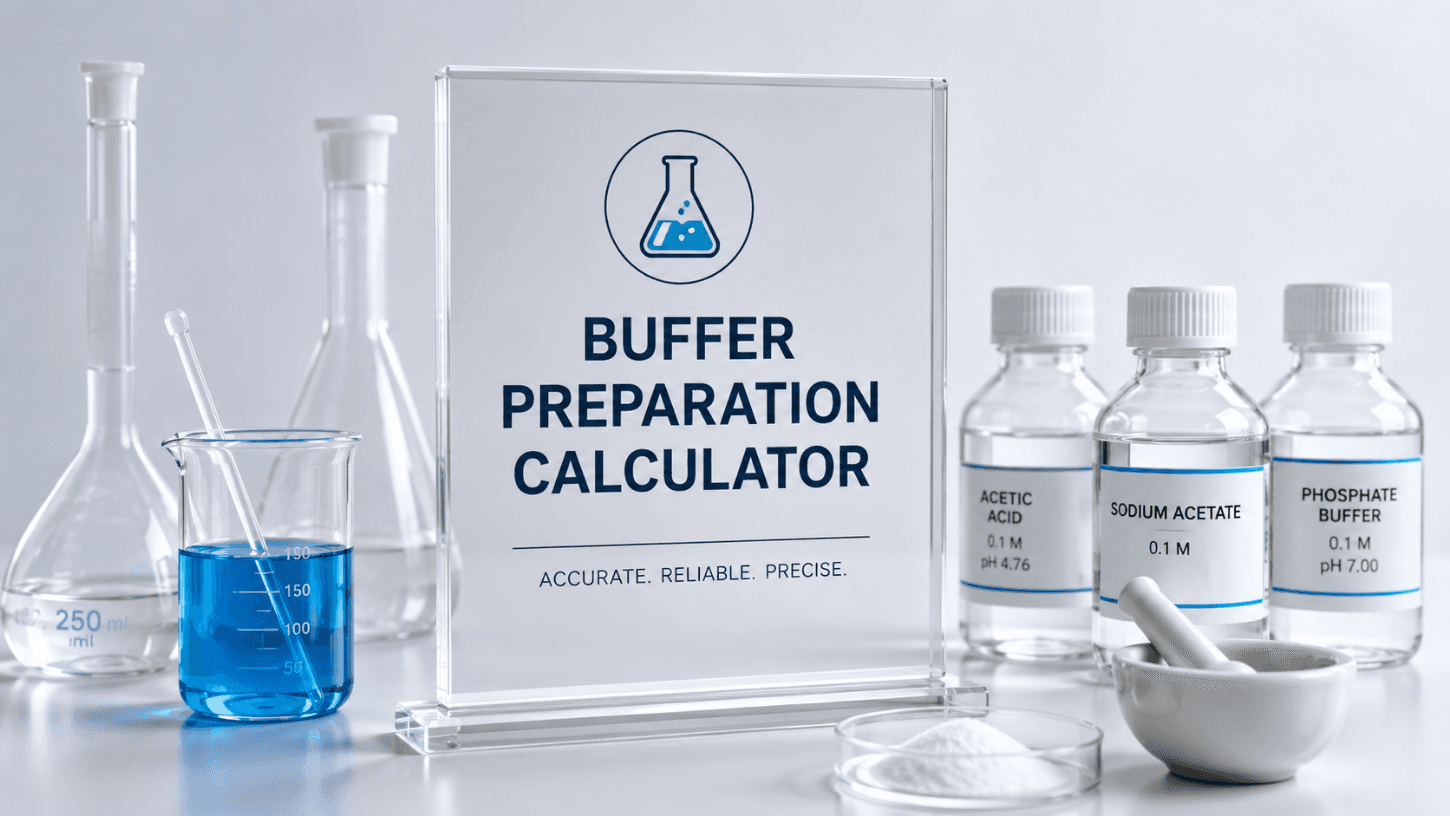
Free online buffer preparation calculator. Select your buffer system, enter target pH, concentration and volume, and get an exact lab-ready recipe with reagent masses and step-by-step instructions. Covers PBS, Tris-HCl, sodium phosphate, acetate, HEPES, MOPS and more.

Read full story

NTD 2,187,825

Inc. VAT